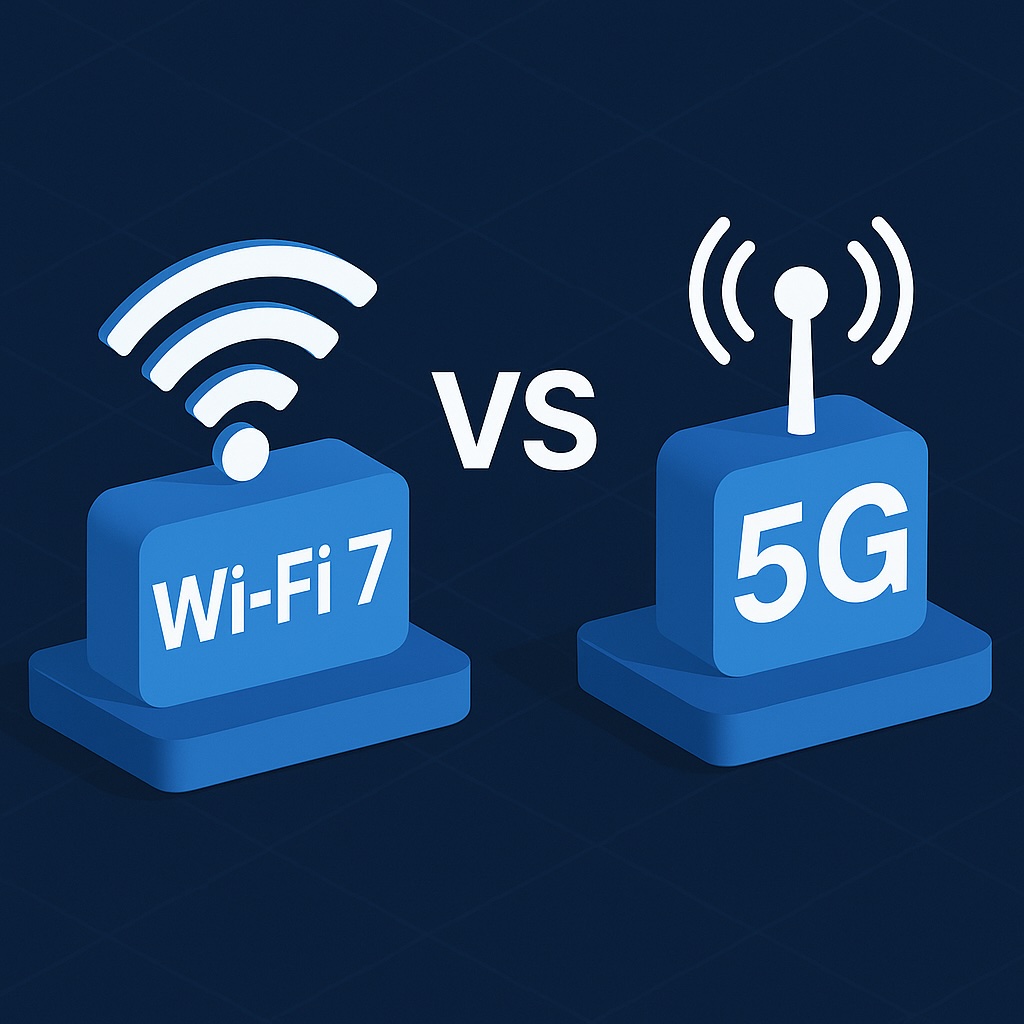
For the past few years, Private 5G has been marketed as the next big thing for enterprise connectivity. Low latency, ultra-reliable, and highly secure, the promise sounded irresistible. But the reality on the ground is quite different. As WiFi 7 matures and becomes commercially available, the cost-benefit equation for Private 5G is collapsing fast. Deploying a Private 5G network means building and maintaining an entirely parallel infrastructure:
•Small Cells and Radios: Unlike WiFi, Private 5G requires careful small cell planning to ensure coverage, especially indoors.
• Core Network Investment: Enterprises must build or lease a private core, which adds complexity and operational overhead.
• Spectrum Licensing (for some regions): While CBRS in the US simplifies some licensing, other regions require more regulatory compliance.
Compared to simply upgrading existing WiFi infrastructure to WiFi 7, which uses the already-deployed LAN cabling, existing controllers, and network management platforms, Private 5G demands significantly more capital and operational expenditures.
A major hidden cost is device compatibility:
• Private 5G requires expensive modems or 5G modules to be embedded in laptops, tablets, industrial equipment, and IoT devices.
• Many enterprise-grade laptops and devices still do not come with native Private 5G modems, requiring external adapters or custom SKUs.
• These 5G modules can add hundreds of dollars per device, significantly raising TCO (total cost of ownership).
WiFi 7, on the other hand, will be natively supported by most enterprise devices in the next 12–18 months at virtually no additional cost to the end-user.
• Multi-Gig Speeds: WiFi 7 brings multi-link operation (MLO), 320 MHz channels, and 4K QAM modulation, delivering multi-gig speeds that match or exceed Private 5G.
• Latency: In real-world enterprise deployments, WiFi 7 latency is more than sufficient for nearly all use cases outside of ultra-specialized industrial automation.
• Spectrum Efficiency: WiFi 7 operates in unlicensed 6 GHz spectrum, offering cleaner channels in most indoor environments.
For 95% of enterprise workloads, office connectivity, collaboration, conferencing, cloud access, and even AR/VR, WiFi 7 meets or exceeds the performance levels that Private 5G promised.
• Private 5G requires specialized RF planning, spectrum management, SIM/eSIM provisioning, and sometimes a dedicated operations team.
• WiFi 7 continues to benefit from decades of simplified deployment models, zero-touch provisioning, cloud-based management, and a large vendor ecosystem.
Enterprises don’t want or need that additional complexity for most office and campus environments.
My question is Where Private 5G Still Makes Sense (Rarely)
To be fair, there are limited niche use cases where Private 5G may still be justifiable:
• Large industrial sites with significant mobility and outdoor coverage needs
• Ports, mines, and airports with safety-critical low-latency automation
• Scenarios where highly licensed spectrum is a strict requirement
But these are edge cases, not mainstream enterprise deployments.
The math is simple: WiFi 7 offers 80-90% of Private 5G’s promised benefits at a fraction of the cost, complexity, and device burden. As enterprises evaluate their next-generation network investments, most will wisely conclude that WiFi 7 is the more scalable, more practical, and far more economical choice.
The Private 5G hype cycle is coming to an end, and WiFi 7 is one of the biggest reasons why.
#WiFi7 #Private5G #EnterpriseNetworking #WirelessTechnology #NetworkInfrastructure #DigitalTransformation #Telecom #ITLeadership #NetworkEngineering #Connectivity #WirelessInnovation #FutureOfNetworking #TechnologyTrends #WiFiVs5G #CostOptimization #InfrastructureInvestment #5GRealityCheck


 Toufic Kourbeh
Leave a comment