Bringing a new IoT or WiFi-enabled device to market isn’t just about designing sleek hardware or writing clean firmware, it’s about solving a real problem and delivering an end-to-end experience. From smart home hubs to industrial WiFi 7 gateways, building a product from zero to launch requires alignment across strategy, engineering, operations, compliance, and customer enablement.
Here’s a deep dive into the journey of building a connected product from 0 to 1.
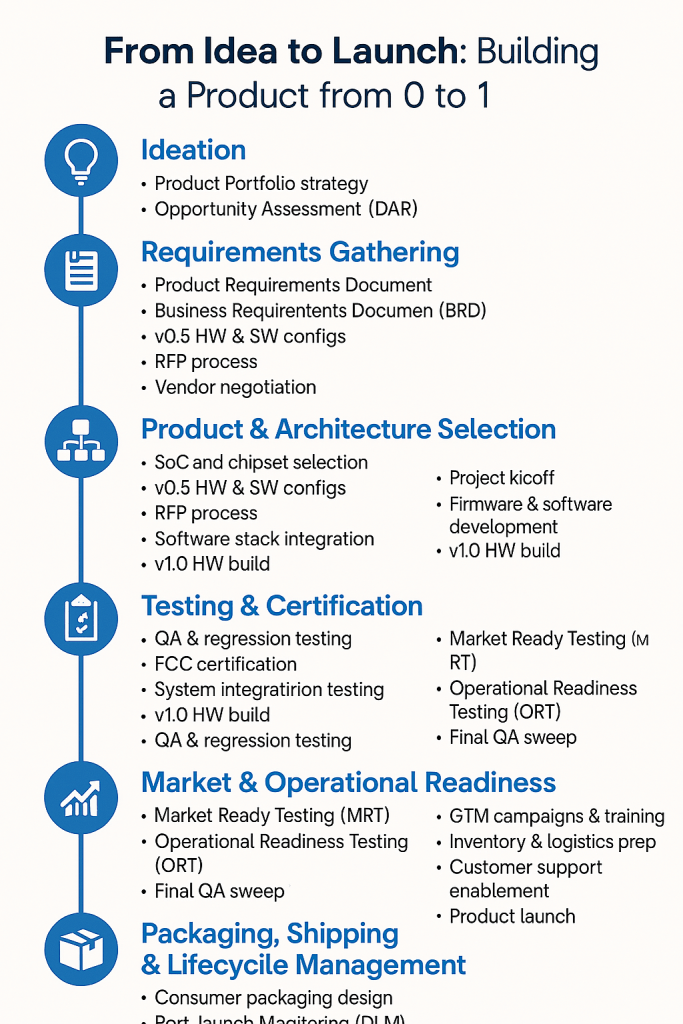
Ideation: Start with a Real Problem
Every successful product begins with a deep understanding of the why. At this stage, you’re not choosing chipsets or drawing enclosures. You’re identifying a problem worth solving.
You can start by aligning with your product portfolio strategy and conducting an opportunity assessment (DAR). Your goal is to ensure that the need exists and that your team is best positioned to solve it. Involve cross-functional stakeholders early: sales, marketing, support, and operations. They often see user pain points long before Product or Engineering does.
Key Questions to be answered at this stage:
• What is the core pain point we’re solving?
• Who is the user, and what is their daily context?
• How are they solving this problem today — and what sucks about it?
Grounding your idea in real-world needs leads to products that users want, not just ones you can build.
Requirements Gathering: Build the Blueprint
Once the problem is validated, it’s time to define the solution. This is where documentation becomes your best friend.
Core Documents:
• Product Requirements Document (PRD): Outlines features, Specs, KPIs, and business goals.
• Business Requirements Document (BRD): Focuses on value, ROI, competitive positioning, and GTM alignment.
During this phase, early v0.5 hardware and software configurations will be created. These are not final specs—they’re iterative, working models that drive technical discussions.
You’ll also launch your RFP (Request for Proposal) process to identify potential vendors, manufacturers, and technology partners. Your output here should be a clear, validated scope and cost estimate, paving the way for architecture and vendor decisions.
Vendor & Architecture Selection: Choose Wisely and Effectively
Your decisions shape your product’s performance, cost, reliability, and time-to-market.
Start by selecting your:
• SoC (System on Chip) and chipset: Based on processing needs, RF performance, power consumption, and cost.
• Firmware architecture: Will it be based on OpenWRT, RDK-B, or a proprietary platform?
• Connectivity stack: WiFi 6E? WiFi 7? Bluetooth LE? Zigbee? Cellular fallback?
In parallel, build your v0.5 HW/SW prototypes and align on the software stack. Ensure you’re evaluating vendors not just on price, but on:
• Supply chain reliability
• Reference designs
• Dev tools and SDKs
• Engineering support
At this stage, you’ll lock down your v1.0 hardware build plan and assemble your BOM (Bill of Materials).
Product Development: Bring It to Life
With the architecture finalized, you’re ready to build. Start with a full project kickoff to align Engineering, QA, Operations, and Compliance. Then dive into:
• Firmware development: Focus on bootloaders, device drivers, network stack, and power management.
• Software stack integration: Middleware, cloud agents, telemetry, and OTA update logic.
• Hardware bring-up: Your first v1.0 prototype boards arrive — now the real fun (and debugging) begins.
Begin QA and regression testing early. If your product has WiFi, Bluetooth, LTE, or 6GHz, start preparing for FCC certification right away.
Testing & Certification: Stress It Until It Breaks
This stage is your device’s crucible. It’s about ensuring it works everywhere, every time, and in every scenario.
You’ll need to run:
• Functional QA: Does the device work as designed?
• Regression testing: Are updates breaking anything?
• System integration testing: Does the hardware + software + cloud + app function as one cohesive system?
• FCC and regulatory certification: You can’t sell or ship without it.
Then come:
• Market Ready Testing (MRT): Will real users be successful with the product?
• Operational Readiness Testing (ORT): Is your company ready to support, integrate, ship, and scale it?
Your goal is to bulletproof the experience before launch. Fixing bugs post-launch is exponentially more expensive.
Market & Operational Readiness: Prep the Launch Pad
By now, the product is stable. But your organization needs to be ready too. Run Employee Field Trials (EFT) to validate edge cases and real-world usage. Make sure:
• GTM teams are trained and aligned on messaging
• Support teams have documentation and FAQs
• Warehousing and logistics are ready for order flow
• Marketing campaigns and pre-launch buzz are in motion
Also, complete your Final QA Sweep — often one last run to verify key flows before mass production.
Packaging, Shipping & Lifecycle Management: Deliver and Sustain
Now, bring it home — beautifully and sustainably.
Design packaging that:
• Protects the device during shipping
• Delivers a premium unboxing experience
• Reflects your brand
Once the product is launched, shift to post-sales operations:
• Post-launch monitoring (DLM): Device health, crash logs, usage patterns. You have to build a BI-based dashboard to monitor this and generate your weekly/monthly reports and findings
• OTA updates fix bugs, patch security issues, and release new features. Depending on the product, this cycle usually lasts 90 days to 6 months.
• Support enablement: Tier-1 and Tier-2 response scripts, escalation plans, and sharing your findings with customer Ops and customer service to educate customer service about potential issues and fixes.
• End-of-life planning: Sunset plans, upgrade paths, recycling.
A successful product doesn’t end at launch — it lives, evolves, and serves users for years.
Building an IoT or WiFi device from 0 to 1 is as much an art as a science. It requires precision, collaboration, and a user-first mindset. At the same time, it is NOT A PROCESS, it is a path because every product is unique, and every product solves a different problem. Every step matters, from defining the problem to validating your build in the field. Follow this blueprint, and you’ll be far better prepared to deliver a product that doesn’t just connect — it resonates.
Want help navigating this journey? Whether you’re building a smart home device, enterprise gateway, or anything in between, I’d love to chat.e. From smart home hubs to industrial WiFi 7 gateways, building a product from zero to launch requires alignment across strategy, engineering, operations, compliance, and customer enablement.
Here’s a deep dive into the journey of building a connected product from 0 to 1.
Ideation: Start with a Real Problem
Every successful product begins with a deep understanding of the why. At this stage, you’re not choosing chipsets or drawing enclosures. You’re identifying a problem worth solving.
You can start by aligning with your product portfolio strategy and conducting an opportunity assessment (DAR). Your goal is to ensure that the need exists and that your team is best positioned to solve it. Involve cross-functional stakeholders early: sales, marketing, support, and operations. They often see user pain points long before Product or Engineering does.
Key Questions to be answered at this stage:
• What is the core pain point we’re solving?
• Who is the user, and what is their daily context?
• How are they solving this problem today — and what sucks about it?
Grounding your idea in real-world needs leads to products that users want, not just ones you can build.
Requirements Gathering: Build the Blueprint
Once the problem is validated, it’s time to define the solution. This is where documentation becomes your best friend.
Core Documents:
• Product Requirements Document (PRD): Outlines features, Specs, KPIs, and business goals.
• Business Requirements Document (BRD): Focuses on value, ROI, competitive positioning, and GTM alignment.
During this phase, early v0.5 hardware and software configurations will be created. These are not final specs—they’re iterative, working models that drive technical discussions.
You’ll also launch your RFP (Request for Proposal) process to identify potential vendors, manufacturers, and technology partners. Your output here should be a clear, validated scope and cost estimate, paving the way for architecture and vendor decisions.
Vendor & Architecture Selection: Choose Wisely and Effectively
Your decisions shape your product’s performance, cost, reliability, and time-to-market.
Start by selecting your:
• SoC (System on Chip) and chipset: Based on processing needs, RF performance, power consumption, and cost.
• Firmware architecture: Will it be based on OpenWRT, RDK-B, or a proprietary platform?
• Connectivity stack: WiFi 6E? WiFi 7? Bluetooth LE? Zigbee? Cellular fallback?
In parallel, build your v0.5 HW/SW prototypes and align on the software stack. Ensure you’re evaluating vendors not just on price, but on:
• Supply chain reliability
• Reference designs
• Dev tools and SDKs
• Engineering support
At this stage, you’ll lock down your v1.0 hardware build plan and assemble your BOM (Bill of Materials).
Product Development: Bring It to Life
With the architecture finalized, you’re ready to build. Start with a full project kickoff to align Engineering, QA, Operations, and Compliance. Then dive into:
• Firmware development: Focus on bootloaders, device drivers, network stack, and power management.
• Software stack integration: Middleware, cloud agents, telemetry, and OTA update logic.
• Hardware bring-up: Your first v1.0 prototype boards arrive — now the real fun (and debugging) begins.
Begin QA and regression testing early. If your product has WiFi, Bluetooth, LTE, or 6GHz, start preparing for FCC certification right away.
Testing & Certification: Stress It Until It Breaks
This stage is your device’s crucible. It’s about ensuring it works everywhere, every time, and in every scenario.
You’ll need to run:
• Functional QA: Does the device work as designed?
• Regression testing: Are updates breaking anything?
• System integration testing: Does the hardware + software + cloud + app function as one cohesive system?
• FCC and regulatory certification: You can’t sell or ship without it.
Then come:
• Market Ready Testing (MRT): Will real users be successful with the product?
• Operational Readiness Testing (ORT): Is your company ready to support, integrate, ship, and scale it?
Your goal is to bulletproof the experience before launch. Fixing bugs post-launch is exponentially more expensive.
Market & Operational Readiness: Prep the Launch Pad
By now, the product is stable. But your organization needs to be ready too. Run Employee Field Trials (EFT) to validate edge cases and real-world usage. Make sure:
• GTM teams are trained and aligned on messaging
• Support teams have documentation and FAQs
• Warehousing and logistics are ready for order flow
• Marketing campaigns and pre-launch buzz are in motion
Also, complete your Final QA Sweep — often one last run to verify key flows before mass production.
Packaging, Shipping & Lifecycle Management: Deliver and Sustain
Now, bring it home — beautifully and sustainably.
Design packaging that:
• Protects the device during shipping
• Delivers a premium unboxing experience
• Reflects your brand
Once the product is launched, shift to post-sales operations:
• Post-launch monitoring (DLM): Device health, crash logs, usage patterns. You have to build a BI-based dashboard to monitor this and generate your weekly/monthly reports and findings
• OTA updates fix bugs, patch security issues, and release new features. Depending on the product, this cycle usually lasts 90 days to 6 months.
• Support enablement: Tier-1 and Tier-2 response scripts, escalation plans, and sharing your findings with customer Ops and customer service to educate customer service about potential issues and fixes.
• End-of-life planning: Sunset plans, upgrade paths, recycling.
A successful product doesn’t end at launch — it lives, evolves, and serves users for years.
Building an IoT or WiFi device from 0 to 1 is as much an art as a science. It requires precision, collaboration, and a user-first mindset. At the same time, it is NOT A PROCESS, it is a path because every product is unique, and every product solves a different problem. Every step matters, from defining the problem to validating your build in the field. Follow this blueprint, and you’ll be far better prepared to deliver a product that doesn’t just connect — it resonates.
Want help navigating this journey? Whether you’re building a smart home device, enterprise gateway, or anything in between, I’d love to chat.


 Toufic Kourbeh
Leave a comment